
- KNX traces its broadcasts to 1920 and went all-news in 1968.
- KTLA calls itself the first commercial TV station licensed west of the Mississippi, on the air since 1947.
- KPFK has been listener-powered since 1959.
Los Angeles broadcasting goes back more than a century. This short account sticks to what the stations themselves record, with dates you can check.
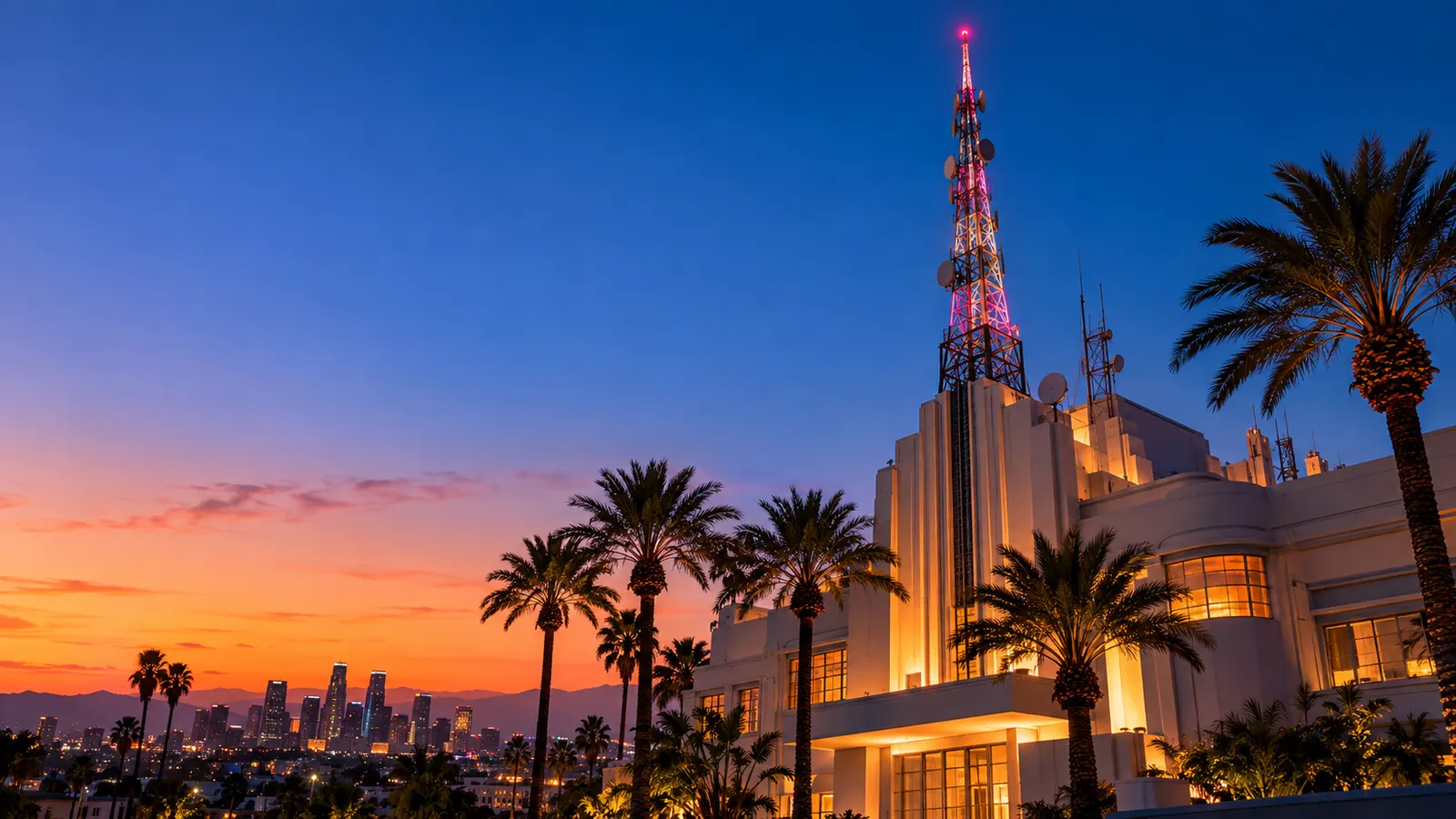
1920: KNX
KNX is the elder of the city’s stations. In a 2013 report, CBS Los Angeles cited broadcasting historian Jim Hilliker saying the station began broadcasting in 1920 and was originally licensed in 1921, making it the oldest radio station in Los Angeles, and that historical documents trace the KNX call letters to May 1922.
1947: KTLA and television in the West
KTLA describes itself as the first commercial TV station licensed west of the Mississippi and says it has been keeping Southern Californians informed since 1947. It still broadcasts on channel 5, and today carries The CW on 5.1 alongside several subchannels.
1959: KPFK and listener-powered radio
KPFK says it has been listener-powered since 1959 and was the first full-time FM station west of the Mississippi powered entirely by listener donations. It is part of the Pacifica network and is governed by an elected local station board with oversight from the Pacifica Foundation.
Tip: Tune to 90.7 FM to hear KPFK and 1070 AM for KNX. Both are still on the air from the same frequencies they are known for.
1968: All news on KNX
On April 15, 1968, eleven days after the assassination of Martin Luther King Jr., CBS-owned KNX greatly increased its news coverage, effectively launching the all-news format it still uses. Within two months the station was covering the killing of Sen. Robert F. Kennedy at the Ambassador Hotel. CBS Los Angeles noted in 2013 that by then the station’s trademark was traffic and weather together on the fives.
The mountain
Much of the region’s broadcasting depends on a few peaks. During the 2009 Station Fire, NBC4 and ABC7 reported that nearly all of the 22 Los Angeles TV stations transmit from Mount Wilson and nearby mountaintop sites, and more than two-thirds of the region’s FM stations broadcast from there as well. Firefighters used controlled burns to protect the observatory and broadcast towers on Mount Wilson. In 2020, during the Bobcat Fire, CBS Los Angeles reported crews again protecting the historic observatory and broadcast towers valued at about $1 billion.
A timeline
| Year | Milestone |
|---|---|
| 1920 | KNX begins broadcasting, per broadcasting historian Jim Hilliker |
| 1947 | KTLA on the air, the first commercial TV station licensed west of the Mississippi |
| 1959 | KPFK begins listener-powered FM broadcasting |
| 1968 | KNX switches to all news |
| 1982 | Multicultural Radio Broadcasting founded; it later runs Chinese-language AM stations in L.A. |
| 2009 | Station Fire threatens Mount Wilson’s broadcast towers |
| 2020 | Bobcat Fire threatens Mount Wilson again |
| 2023 | 89.3 KPCC renames itself LAist 89.3 |
Many languages
Los Angeles broadcasting has long spoken more than English. Multicultural Radio Broadcasting, founded in 1982, says its Los Angeles AM stations produce their own Chinese-language programming in Mandarin and Cantonese, and Radio Korea broadcasts on AM 1540. Univision 34 and Telemundo 52 cover the region’s news in Spanish. See Asian-Language TV and Radio in Los Angeles: Chinese, Korean and More and Spanish-Language TV and Radio in Los Angeles.
Today
Most of the stations in this story are still on the air, now joined by free streaming channels and apps. You can find them all in Los Angeles Radio Stations by Frequency: FM and AM Dial Guide and Los Angeles TV Channels: Every Free Over-the-Air Station.
What has stayed the same
Formats, owners and technology have changed many times, but a few things have held. KNX still serves news on 1070 AM, KTLA still broadcasts on channel 5 and KPFK still depends on its listeners. LAist, which renamed itself from KPCC in 2023, said in announcing the change that the KPCC call letters would still be heard at the top of every hour, because the FCC requires stations to identify themselves by their call letters.
Public broadcasting also grew around the region’s colleges. The FCC’s public files show public radio licenses held by Cal State Long Beach’s research foundation, Cal State Northridge, Loyola Marymount University, the Pasadena Area Community College District, the Santa Monica Community College District and the University of Southern California, and a TV license held by the Los Angeles Unified School District.
Where to learn more
Stations’ own websites are the best place to dig further. KTLA’s about page, KPFK’s history page and CBS Los Angeles’s archive of KNX stories all describe milestones in their own words. Local libraries and university archives hold much more, from program schedules to photographs of early studios.
If you collect old radios, many still work on today’s AM stations, since KNX, KFI and the other AM stations broadcast in the same analog format they always have. FM sets work too. Television is different: analog TV is long gone, so old sets need a digital converter box to show anything.